Your checkout was cancelled and nothing was charged. The book is still here whenever you're ready.
The book from the channel
Your first trip to Japan, decided in the right order.
Before You Land in Japan takes you from "should we go, and when?" to a dated, costed plan you can book yourself. It covers the season, the route, the budget and the booking order, then what to do when you're actually there.
$29PDF ebook, 382 pages
- Instant download
- Reads on phone, tablet or computer
- Secure payment by Stripe

Where you probably are
A folder of screenshots, and no idea which of them is still true.
You've watched hours of Japan videos. Half of them contradict the other half, and none of them tells you when their numbers were checked. Meanwhile the large decisions are waiting: which month, how many cities, how many nights, whether the rail pass pays, what to book first.
Those decisions are made at a kitchen table months before you fly. Once you land, nobody can give you a different month or the four days you'd spend on trains.
- Getting the big decisions wrongThe wrong season, too many cities, a pass you didn't need. Mistakes like these can't be fixed once you're there.
- Keeping up physicallyThe walking, the stairs, the heat. Most guidebooks seem to assume you're twenty-five with a backpack.
- Being rude without knowing itShoes, baths, trains, temples. You want to know the few rules that matter, and why they exist.
What changes
From scattered advice to a plan you trust.
Before
- Tabs, screenshots and saved videos, all undated
- A route that looked fine on a map
- A budget guessed in dollars
- Worry about the bath, the trains and the manners
After
- A month chosen for your heat tolerance, crowds and budget
- A route measured in hours, with nights per base
- A costed daily budget and a clear answer on the rail pass
- A booking countdown, and cards for your pocket on the day
What the book is
Organized by the order the decisions arrive, not by city.
Almost every book about Japan is organized by place: Tokyo, then Kyoto, then Osaka, with the sights listed. That's the right shape for a book you carry around, and the wrong shape for the problem you have now, which is not "what's in Kyoto?" but "when should I go, for how long, what will it cost, and what do I book first?"
So this handbook follows your trip from the first question to the flight home. Read Parts One and Two before you book anything. After that, go straight to the chapter you need.
- Part 1DecidingWhether, when, how long, with whom
- Part 2PlanningRoute, bases, budget, rail pass
- Part 3BookingWhat to lock first, and what sells out
- Part 4PreparingEntry, money, phone, packing, medicines
- Part 5ArrivingFirst 24 hours, trains, luggage
- Part 6Being thereShoes, baths, eating, temples, shopping
- Part 7Problems and homeWhen something goes wrong, the last day
- Part 8Three days, assembledTokyo and Kyoto, hour by hour
- Part 9ContextParticular needs, history, the year
What you receive
A complete handbook, not a list of tips.
One PDF you keep. It's typeset for easy reading at a generous size, with the tables, diagrams and cards you'll use during planning and on the ground.
- 382pages
- 40chapters in nine parts
- 26worksheets, checklists and itineraries
- 9pocket cards to carry on the day
- 75+dated "Checked" notes on prices and figures
One idea from the book
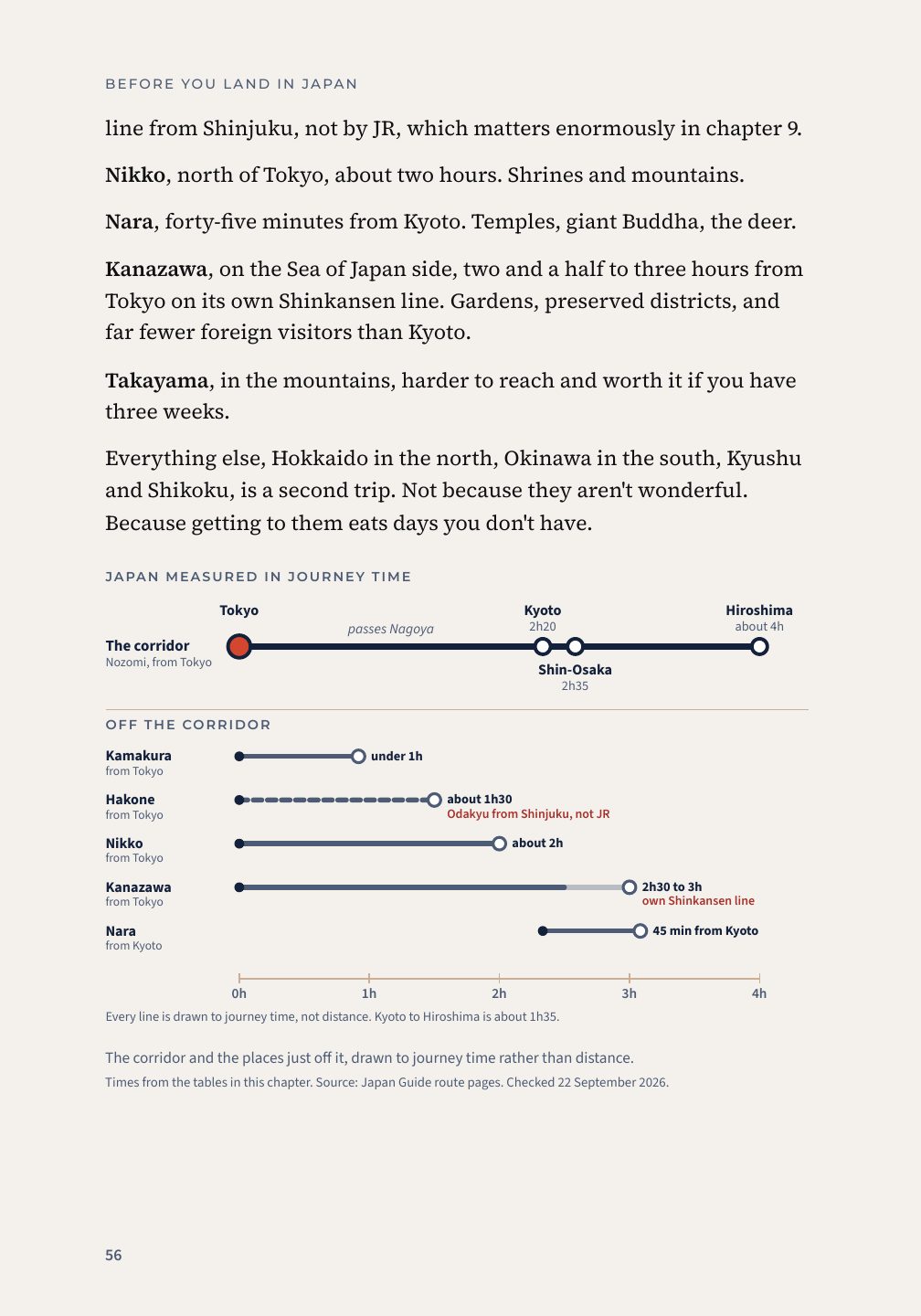
Stop measuring Japan in miles.
Almost everything on a first trip sits on one railway line, running southwest from Tokyo through Kyoto and Osaka to Hiroshima. The book calls it the corridor. Once you see it, the classic first route stops looking unimaginative and starts looking obvious: on the line, a travel day costs you two hours instead of six.
Chapter 5 gives you the full time and fare matrix. Chapter 6 turns it into route shapes for 7, 10, 14 and 21 nights, and the five routes that don't work.
Mariko's verdictAnything under an hour is a day trip without a second thought. One to two hours is a day trip you should plan properly. Beyond two hours, move your suitcase and stay the night.
Why you can trust the figures
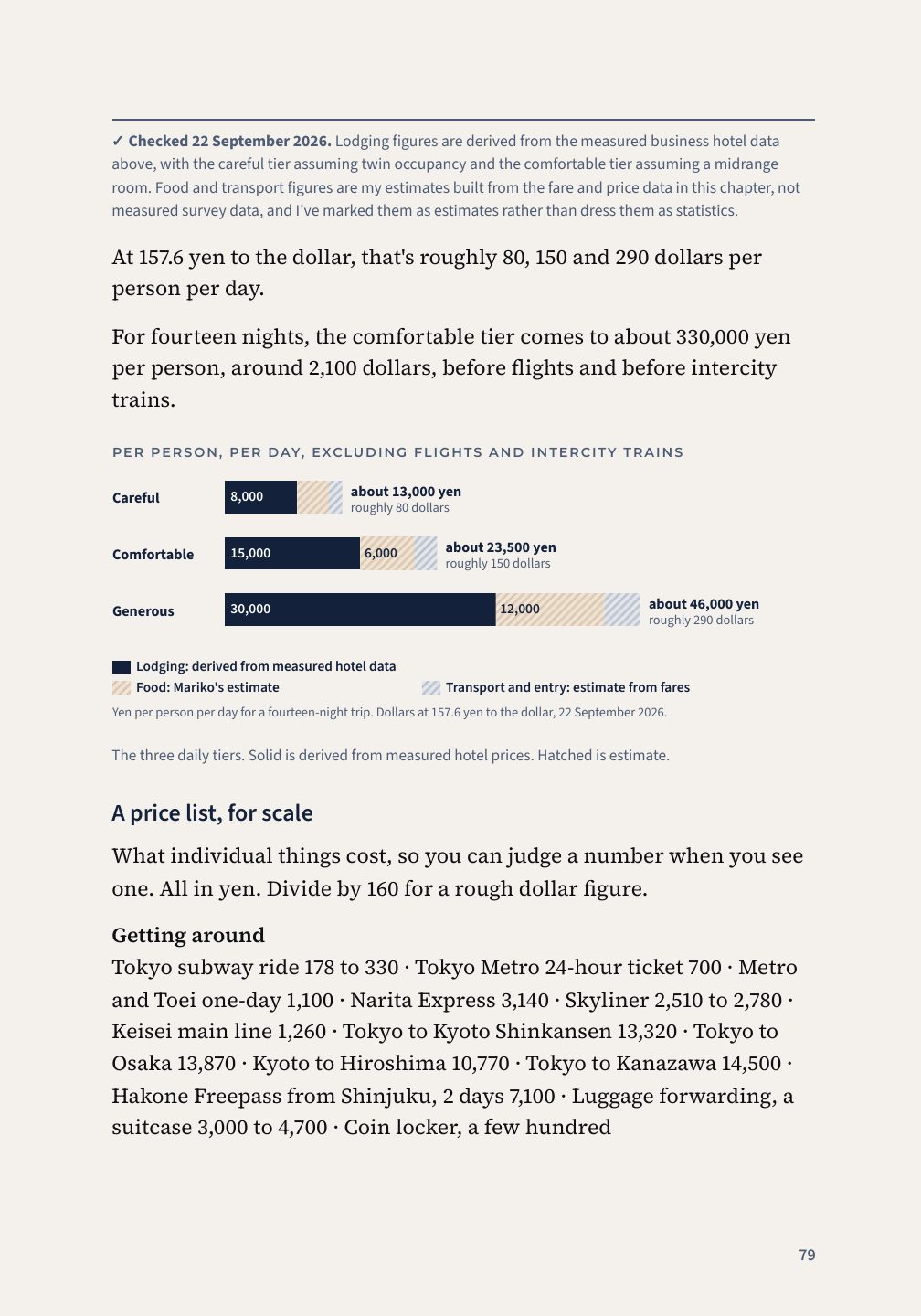
A price with no date isn't information.
The most common failure in travel writing about Japan is a confident number from years ago with nothing to tell you how old it is. In this book, every price, fare, tax and temperature carries the date it was checked and where it came from.
At the back, a refresh log lists everything in the book that expires and exactly where to check it. Where a mistake could cost you something you can't get back, such as a medication at customs or a refund at the airport, the book names the official authority so you can confirm it close to your departure.
As of March 2020, 91.8 percent of the 3,580 priority stations had elevators, ramps or equivalent step-free facilities.
Checked 22 September 2026. Source: Government of Japan, Highlighting Japan, March 2021.
Verify before you go. Medication rules are set by Japan's Ministry of Health, Labour and Welfare and they change. Check the current list yourself before you pack.
Two examples from the book, chapter 1 and the introduction. Every dated figure follows the same pattern.
Look inside
Real pages from the book.
Tap any page to see it larger.
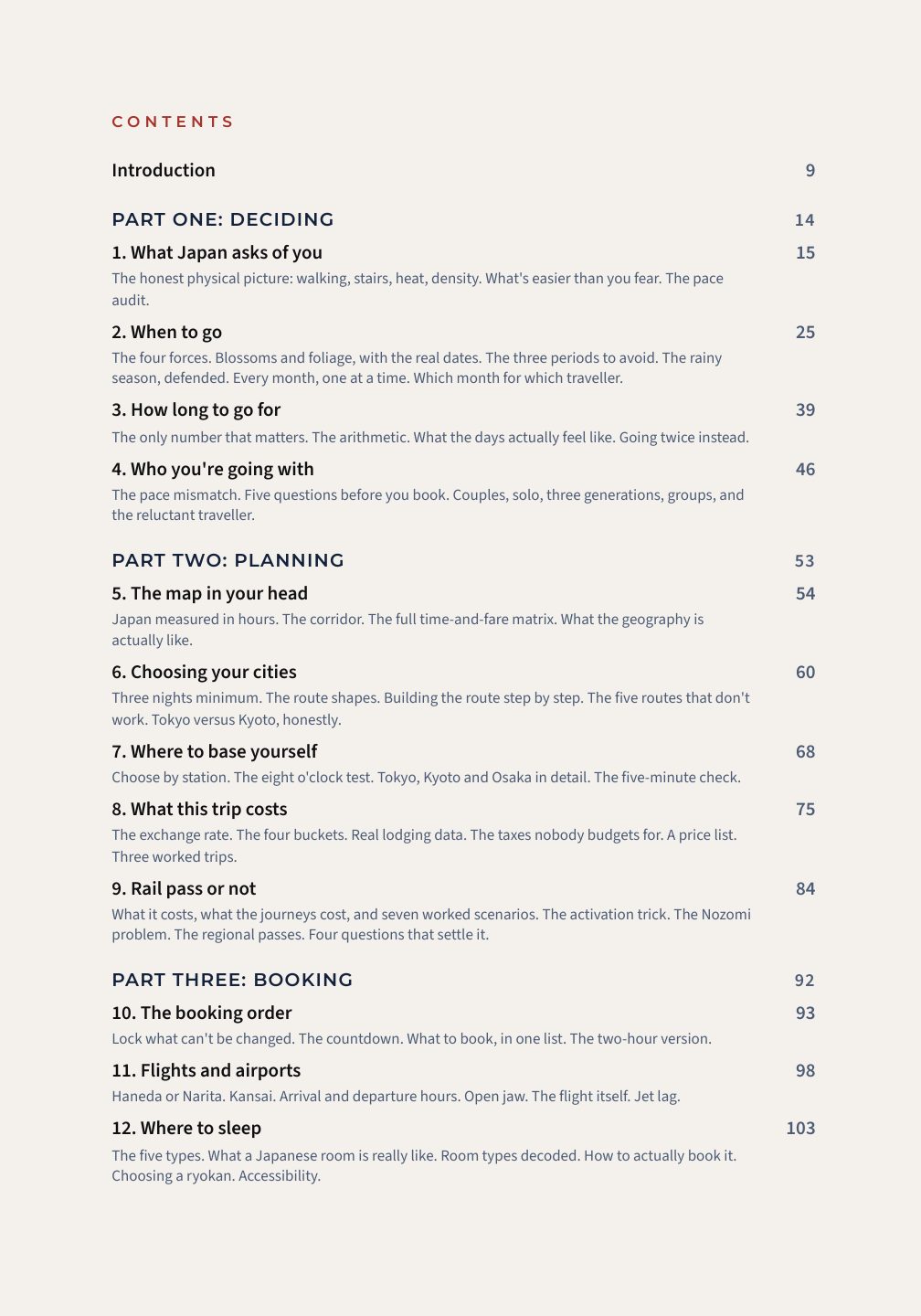
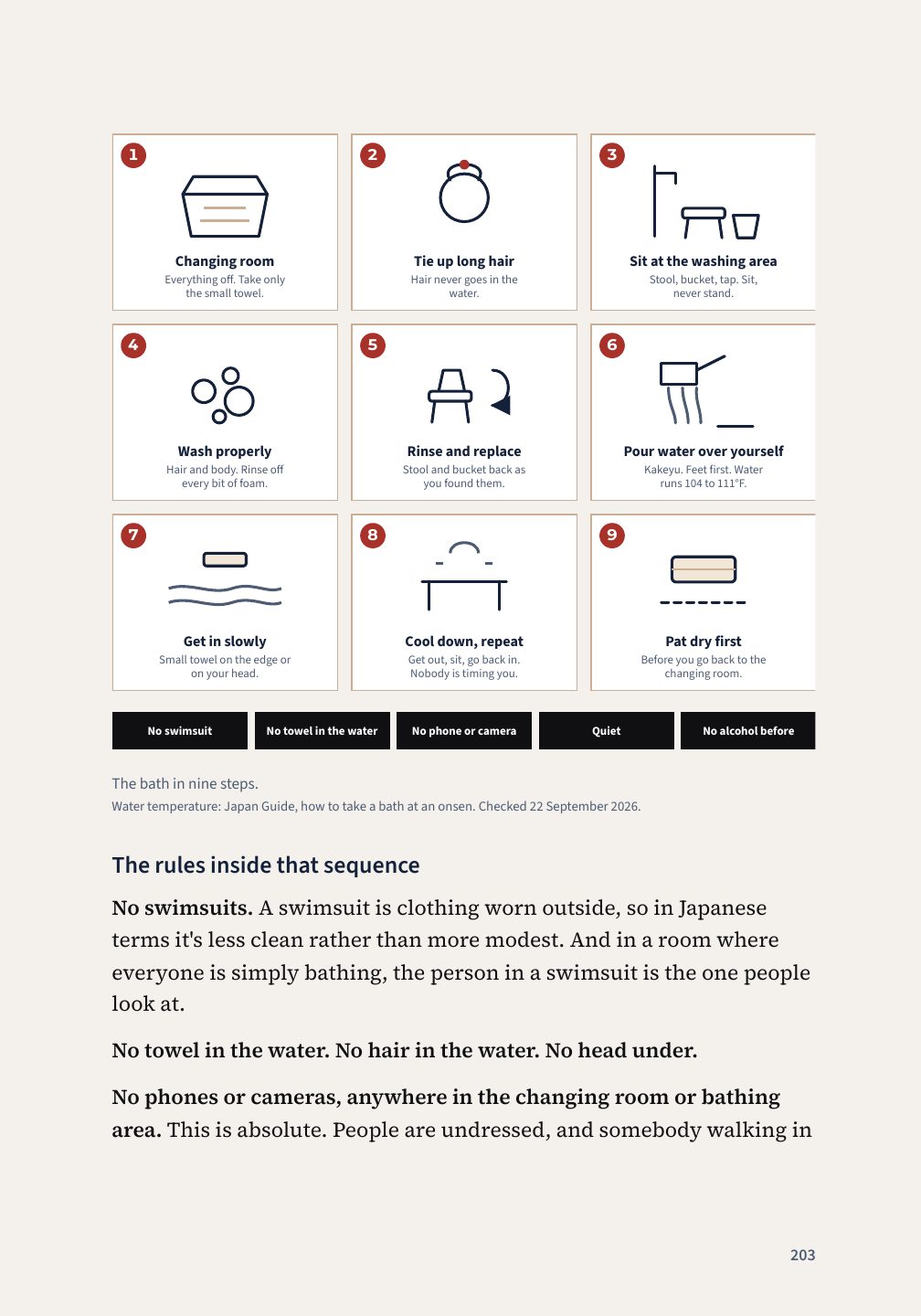
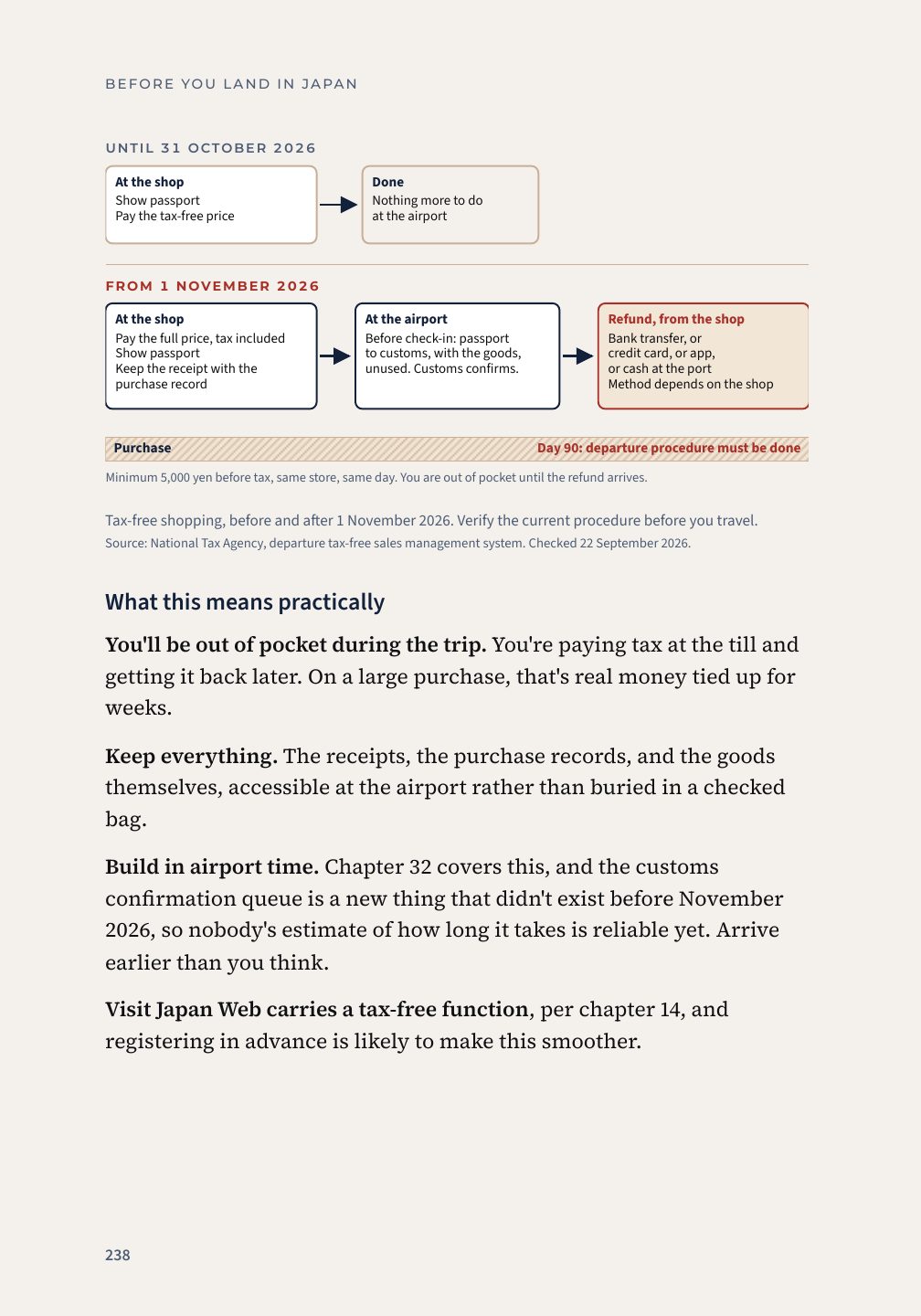
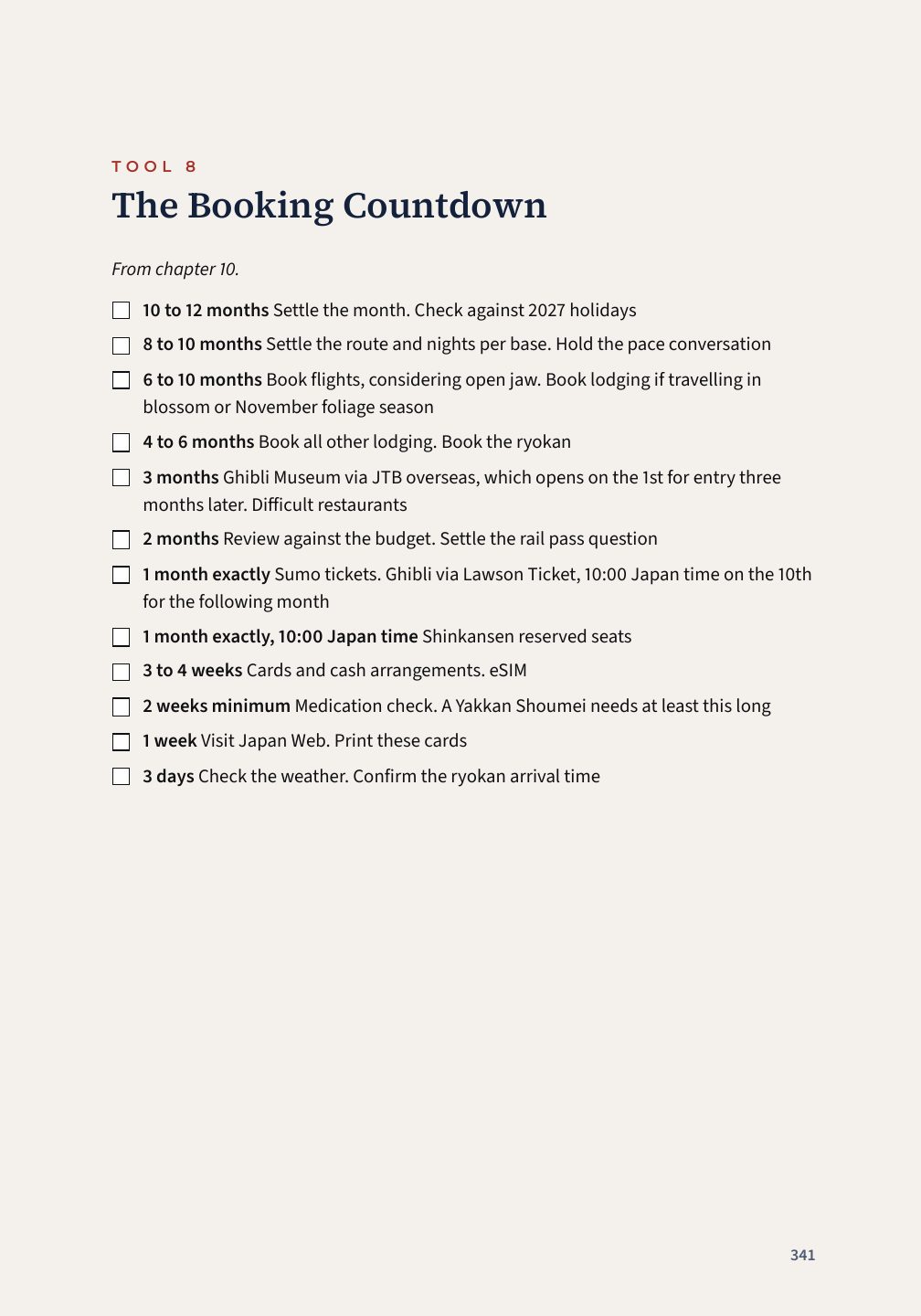
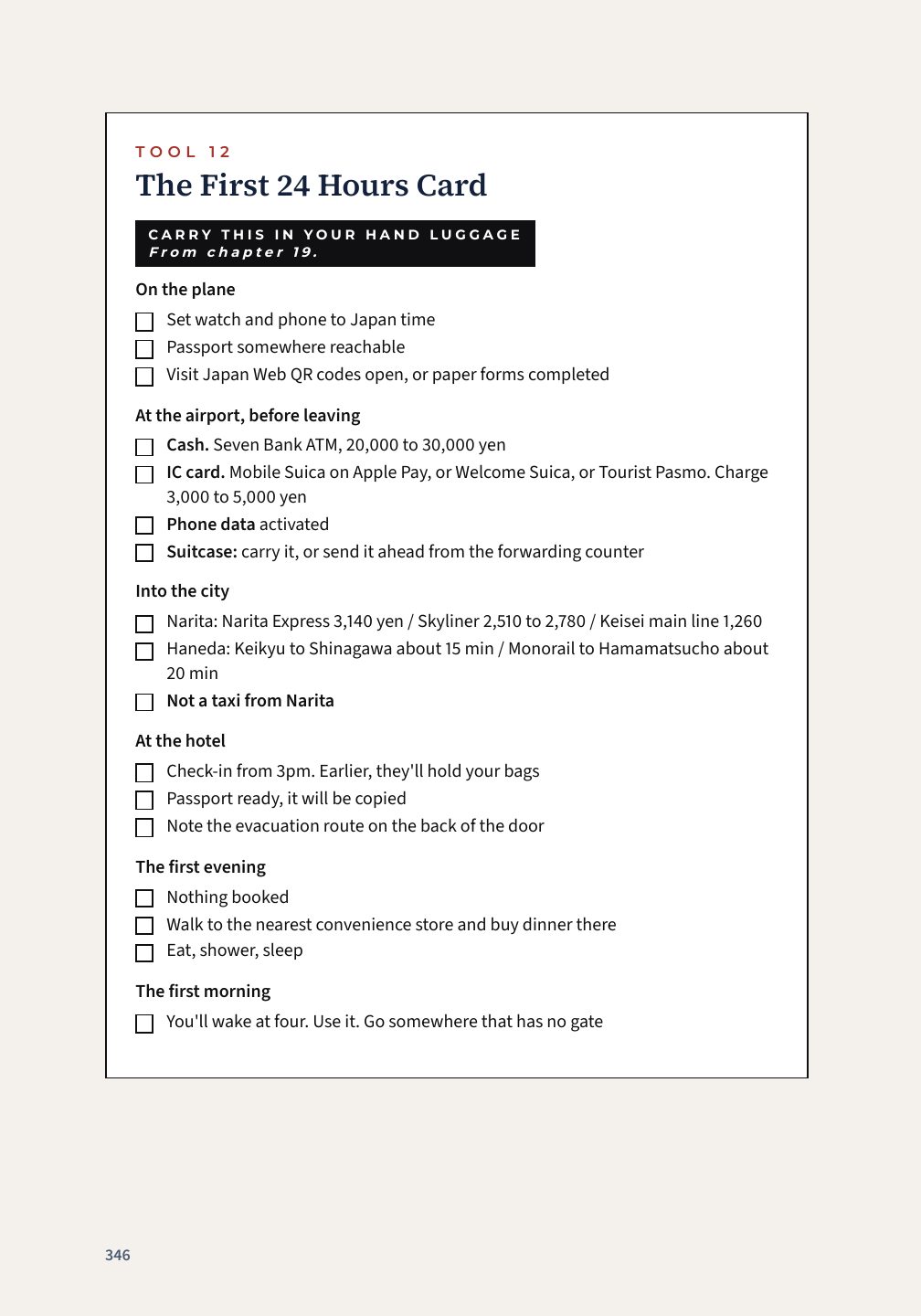
Full contents
Forty chapters and a toolkit.
Part OneDeciding
- What Japan asks of you. The honest physical picture: walking, stairs, heat, density.
- When to go. Blossoms and foliage with the real dates, the periods to avoid, every month in turn.
- How long to go for. The only number that matters, and the arithmetic.
- Who you're going with. The pace mismatch, and five questions before you book.
Part TwoPlanning
- The map in your head. Japan measured in hours, and the full time and fare matrix.
- Choosing your cities. Three nights minimum, the route shapes, the five routes that don't work.
- Where to base yourself. Choose by station, and the eight o'clock test.
- What this trip costs. The four buckets, real lodging data, three worked trips.
- Rail pass or not. The worked scenarios, the Nozomi problem, the regional passes.
Part ThreeBooking
- The booking order. Lock what can't be changed, then the countdown.
- Flights and airports. Haneda or Narita, arrival hours, open jaw, jet lag.
- Where to sleep. What a Japanese room is really like, choosing a ryokan, accessibility.
- The things that sell out. Ghibli, sumo, Shinkansen seats, restaurants.
Part FourPreparing
- Documents and entry. Visit Japan Web, immigration, customs.
- Money before you go. Cards versus cash, which ATMs work.
- Your phone. eSIM, SIM or pocket wifi, and the apps that matter.
- Packing for Japan. Shoes first, and what to leave behind.
- Your body and your medicines. Import rules, the heat, pharmacies, doctors.
Part FiveArriving and moving
- Your first 24 hours. From the plane to the first convenience store.
- The trains. The IC card, reading a station, the Shinkansen.
- Your luggage. Why not to carry it, and how to send it ahead.
- Inside a city. Tokyo, Kyoto and Osaka, and the Kyoto bus problem.
Part SixBeing there
- The rules, and why. One question that answers everything.
- Shoes, floors and thresholds. The genkan and the toilet slippers.
- Trains and public space. Silence, queues, escalators, priority seats.
- Bathrooms and baths. The toilet panel, the bath step by step, tattoos.
- Eating. What every kind of restaurant is and costs, paying, dietary needs.
- Temples and shrines. Telling them apart, the two prayer sequences.
- Shopping and tax-free. The system that changed on 1 November 2026.
- Talking to people. Twenty phrases, and reading eight characters.
Part SevenProblems and home
- When something goes wrong. Lost passports, missed trains, illness, earthquakes.
- The last day. The airport sequence and the last-night checklist.
Part EightThree days, assembled
- A day in Tokyo. Three days written out hour by hour.
- A day in Kyoto. The morning that makes the trip.
- The other days. Osaka, Hiroshima and Miyajima, a ryokan night, Nara, Kanazawa.
- The day trips, properly. Eight of them, with an honest verdict on each.
Part NineContext and particular needs
- Traveling with particular needs. Mobility, diet, solo travel, grandchildren.
- A little history, so the places mean something.
- The Japanese year. What happens in every month.
- When you come back. Where to go on a second trip.
Back of the bookThe Reader Toolkit
Twenty-six tools, including:
- The Pace Audit and the Season Chooser
- The Budget Worksheet and the Rail Pass Break-Even Worksheet
- The Booking Countdown and the Master Pre-Departure Checklist
- Worked 10, 14 and 21-night itineraries
- Nine CARRY cards: first 24 hours, trains, etiquette, phrases, emergency, departure, city cheat sheets, phrases by situation, the menu decoder
- The Refresh Log: everything that expires, and where to check it
Plus a glossary and a full list of references.
Is it for you
Written for one kind of reader.
It's for you if
- This is your first trip to Japan and you'd rather be told the truth than be flattered.
- You're over fifty and every guidebook seems to assume you have unlimited knees.
- You have a folder of screenshots and no idea which of them is still true.
- You're planning it yourself and want to make the big decisions once, correctly.
It isn't for you if
- You want to be told which temple is the most beautiful, or given a top ten of things to eat. It isn't a sightseeing guide.
- You've been to Japan before. You'll know most of Parts Five and Six already.
- You're heading mainly to Hokkaido, Okinawa or Kyushu. The book stays inside the corridor where a first trip happens.
- You're moving to Japan to live, work or study.

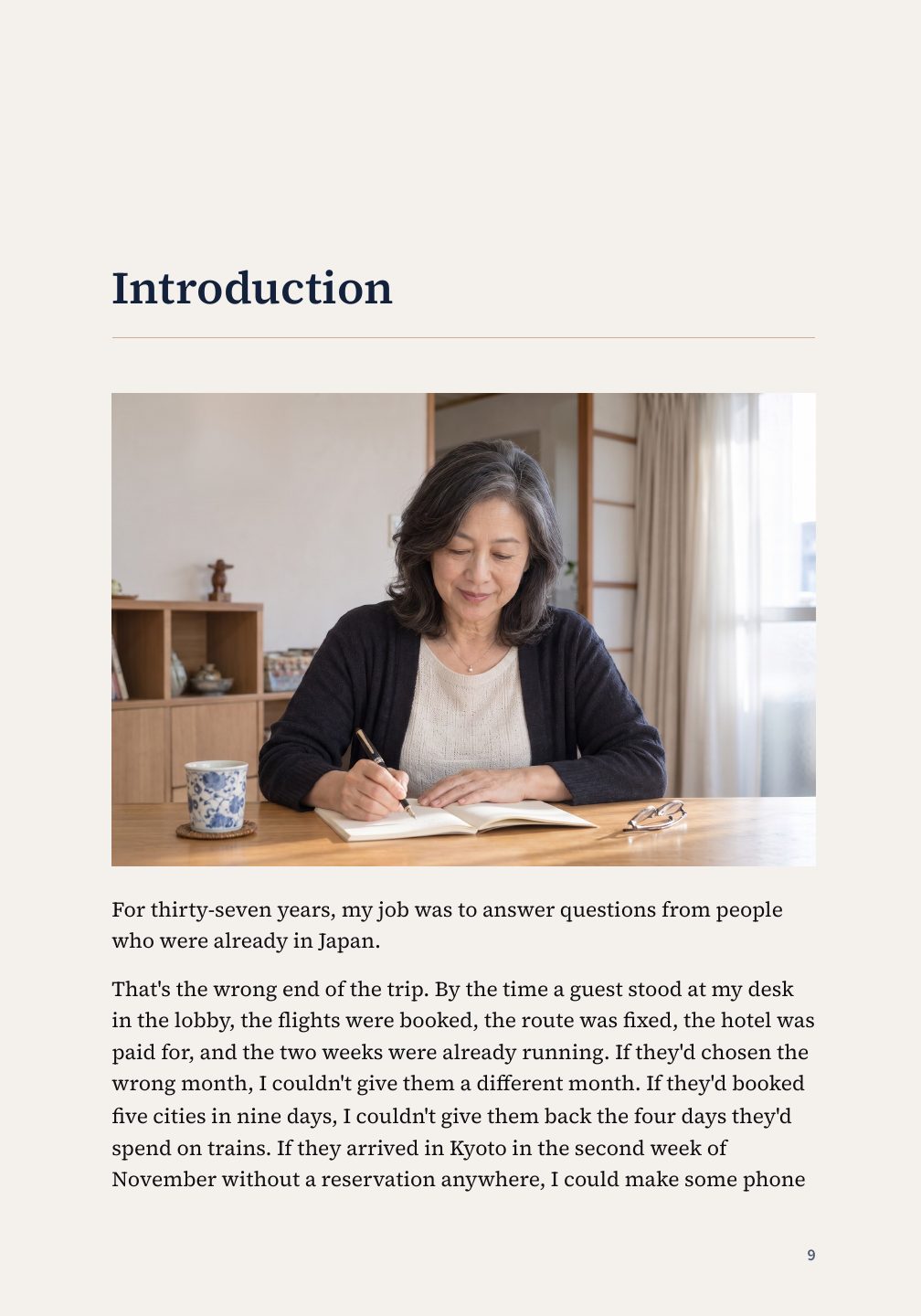
From the introduction
By the time a guest stood at my desk in the lobby, the flights were booked, the route was fixed, the hotel was paid for. The large problems had been decided months earlier by someone sitting at a kitchen table in Ohio with eleven browser tabs open.
This book is for that kitchen table.
Mariko Aono is the voice of the Mariko Aono channel on YouTube. The book is written in her voice, in the first person, the way she talks to you in the videos.
Questions
Before you buy.
What exactly do I get?
One PDF file, 382 pages, 7 by 10 inches. It includes the full book, the 26-tool Reader Toolkit, a glossary and the references. You download it right after payment, and the download link is also emailed to you.
Can I read it on my phone or tablet?
Yes. A PDF opens on any phone, tablet or computer. On an iPhone or iPad, open it in Books to keep it on your shelf. It reads most comfortably on a tablet or computer, and the text is set at a generous size.
Can I print it?
Yes. The toolkit's worksheets and cards are designed to print in black and white on ordinary paper. Print only the pages you need.
How current is the information?
Every price and figure carries the date it was checked and its source. The refresh log at the back lists everything that expires and where to check it, so you can confirm the few things that matter close to your departure date.
Is it a sightseeing guide?
No. It won't rank temples or list the top ten dishes. It handles the decisions and situations that decide whether the trip goes well: season, route, bases, budget, rail pass, booking order, arrival, trains, baths, eating, shopping and what to do when something goes wrong. Parts Eight and Nine include worked days in Tokyo and Kyoto and eight day trips.
How do I pay?
Checkout is handled by Stripe, a payment processor used by millions of businesses. You can pay by card, Apple Pay or Google Pay, plus other methods Stripe offers in your country. We never see or store your card details.
Is tax included?
Yes. The price is in US dollars and includes any sales tax or VAT due where you live. Your receipt shows the breakdown.
Can I get a refund?
Because the ebook is delivered immediately, sales are final once your download is available. At checkout you'll be asked to confirm that you want immediate access. If the file doesn't arrive or won't open, write to us and we'll fix it.
I lost my download link.
Look for the email with the subject "Your copy of Before You Land in Japan". If you can't find it, use the help page with the email address you used at checkout.
Before you book anything
Make the big decisions once, in the right order.
Read Parts One and Two before you spend any money. They're short, and they hold the four or five decisions everything else depends on.
$29PDF ebook, 382 pages
- Instant download
- Link also sent by email
- Tax included